The Garden Path as a Line of Composition
Plan a garden path as a line of composition to connect useful destinations, guide movement, and frame changing views without treating the route as decoration.
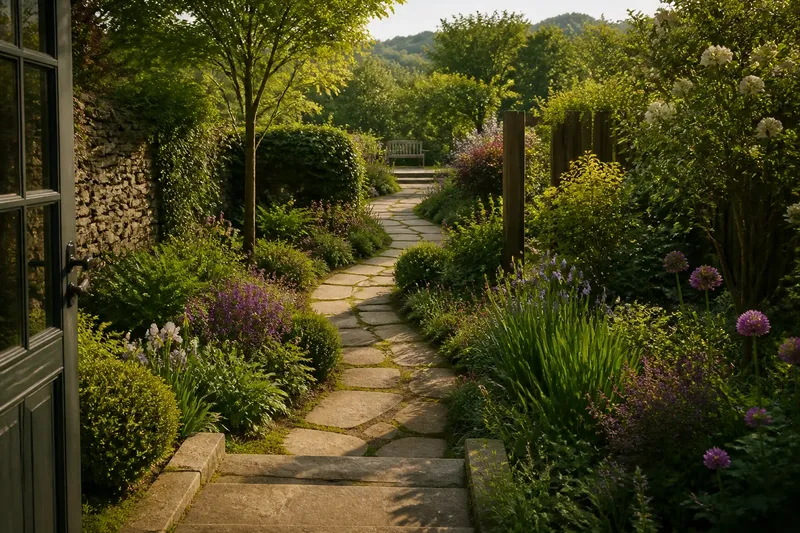
Where should a garden path go if you want it to lead somewhere and make the walk more interesting? Plan the garden path as a line of composition: begin with the places people need to reach, then shape the route to guide movement and reveal views.
That order keeps the path from becoming a decorative mark laid across the garden. Its direction, bends, and relationship to nearby planting affect how a visitor enters, pauses, and looks beyond the next few steps. Settle those choices before selecting a surface or edge.
Start with destinations
Write down the places the route needs to connect. These might include a gate, patio door, seating area, shed, compost area, or a passage around the house. Include everyday destinations as well as occasional ones; a route serving only a scenic seat can make routine movement awkward.
Look for existing desire lines. A worn strip through grass or a habitual turn around a planted bed can reveal where movement is already being asked of the garden. It is not automatically the route to adopt, but it deserves attention.
Mark each destination on a simple plan or with temporary markers outdoors. Stand at the entrances and imagine walking between them. Check for doors that open into the route, tight corners, and places where someone carrying a tray, tools, or a watering can would need room to pass.
Separate necessary connections from optional ones. A path to a frequently used door usually benefits from a direct, legible line; a less-used route can take a more gradual course if it reveals something worth seeing. This keeps a scenic curve from making a daily trip feel needlessly indirect.
Read the garden views
Stand where people will begin and end their walk. Note what is visible from each point: a doorway, tree, wall, change in ground, or opening between plants. Then walk the space rather than judging it only from a plan.
Notice how views change with movement. A boundary that dominates from the entrance may become less noticeable after a turn, while a small opening may appear only from a particular approach. The route can make those changes part of the experience without adding a feature at every bend.
Choose one or two views to connect deliberately. The path might bring a distant tree into view as someone leaves the house, or lead toward a seat while keeping it partly screened until the final approach. Decide when the destination should become clear.
Keep practical sightlines in mind. Where a route meets a driveway, gate, or busy crossing, make the approach easy to read. Avoid putting a tall obstruction where walkers need to see one another.
Sketch the route outside
Use a garden hose, rope, or loose line of marking material to lay out a possible route. These are temporary planning tools, not construction instructions. Make broad, readable turns rather than a string of small wiggles, then view the line from the house, entrance, and destination.
Walk the proposed route in both directions. A bend that seems purposeful on the way to a seat may feel like an unnecessary detour on the return. Check whether the route points toward an intended view, passes close enough to the places it serves, and fits the surrounding space.
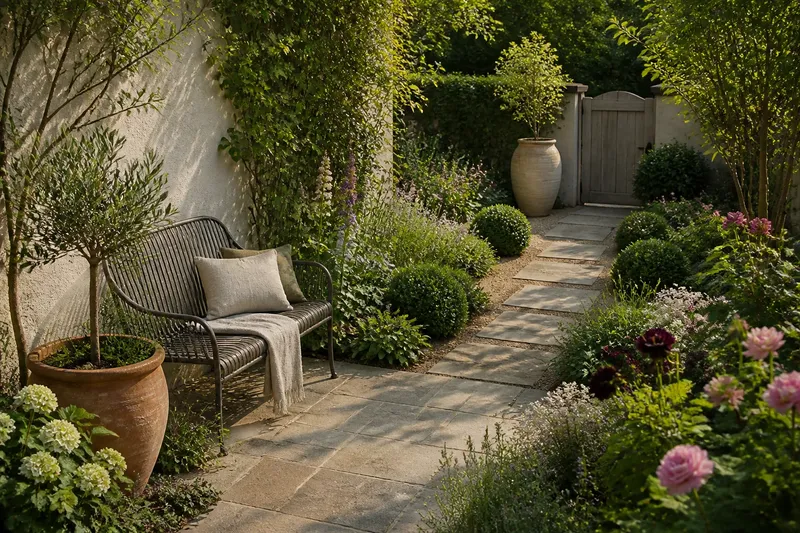
Say you have a narrow side garden, a back door, and a small bench near the far boundary. You place a hose from the door toward the bench, then shift one curve so the route passes an existing opening in a screen. From the door, the bench stays partly out of sight; at the opening, both the route and destination become easy to read. The tradeoff is a slightly less direct line in exchange for a gradual reveal; if the curve makes the daily walk feel awkward, straighten it.
Try a straight line before deciding that a curve is better. A direct route can provide a calm visual axis or make a compact space feel coherent. A curve earns its place when it responds to a constraint, connects a view, or improves the approach—not simply because paths are expected to bend.
Shape pace and attention
A path sets a walking rhythm. A direct run encourages people to continue; a turn can slow them or redirect their gaze. Use that effect with restraint. If every short stretch changes direction, the route can become hard to read.
Place pauses where there is a reason to stop: a seat with a useful outlook, a broad threshold, or a point where routes meet. A widening can signal that people may linger, but it should not obstruct a door or pinch a passage. Keep the main walking line clear beside any place to stand.
Consider what the path reveals at eye level. Low plants may leave a long view open while defining the edge; a taller screen can close one sightline and open another. Decide whether each section should feel exposed, enclosed, or transitional, and use the route’s position to support that effect.
It is not worth adding a bend just to hide an ordinary destination or placing an object beside every curve to justify it. A clear, comfortable route through a modest garden can have more character than a complicated one.
Check garden path layout?
How wide should a garden path be?
Choose a width that suits who uses the route and what they carry. A path for one person moving between beds differs from a shared approach to a doorway; allow for passing where needed, and check relevant surface and access guidance before construction.
Should a garden path be straight or curved?
Use a straight line when a direct connection or clear axis serves the garden. Choose a curve when it responds to an obstacle, links views, or shapes the approach; remove bends that add distance without changing the experience.
How do I make a path lead to a view?
Stand at the entrance and identify the view you want people to notice. Adjust the route to point toward it, frame it between existing elements, or reveal it after a turn, then walk the line both ways to see whether the effect feels natural.
Where should a garden path meet a patio?
Connect the path to a part of the patio people can reach without cutting across seating or interrupting a doorway. If the route serves several destinations, make the junction clear rather than leaving walkers to guess which way to go.
Test entrances and junctions
Look closely at the beginning and end of the route. A path should visibly meet a door, gate, terrace, or destination instead of stopping short and leaving an awkward strip to cross. At a junction, use alignment and the relationship between routes to make the likely direction clear.
Check how the path meets planting and boundaries. Leave room where maintenance or access is needed, and avoid pinching the route between a wall and spreading plants. If the path passes a gate, confirm that the gate can open freely and that someone waiting there will not block people walking through.
Use product labels, manufacturer instructions, and local requirements when surface choice, access, drainage, or construction depends on them. Keep layout decisions separate from technical work that calls for qualified help.
Review the full route
Before making the route permanent, walk it at an ordinary pace from every entrance it serves. Check whether the next direction is clear, whether the destination appears at a useful moment, and whether each bend or pause has a purpose. Look back as well; a path should make sense on the return journey.
View the line from indoors and from the garden’s main gathering place. A route seen through a window becomes part of the composition even when nobody is walking on it. If it divides the space awkwardly from that viewpoint, shift the line or change where it meets the destination.
Use this final check before settling the garden path layout:
- Observe whether the route meets every everyday destination; if a door, gate, or work area is missed, adjust the line or add a clear connection.
- Observe whether doors and gates can open without meeting the route; if they swing across it, move the path or revise the junction.
- Observe whether two people or someone carrying garden tools can pass where passing is expected; if the route feels pinched, widen that section or create a separate passing place.
- Observe whether each bend changes the view, avoids an obstacle, or improves the approach; if it has no clear purpose, straighten or remove it.
- Observe whether the destination is easy to find from the entrance; if it is confusing, clarify the route’s alignment or make the junction more legible.
- Observe whether planting or a boundary blocks a needed sightline; if it does, shift the route or lower or reposition the obstruction.
- Observe whether the path sits well from the house and gathering area; if it divides the garden awkwardly, alter its course or meeting point.
Garden path layout works best when movement and views support one another. Keep the route direct where daily use calls for clarity, and let it slow or turn only where the space offers a reason. A visitor who has not seen the plan can help expose a confusing junction: ask where they would walk next, then revise that point if their choice is unclear.