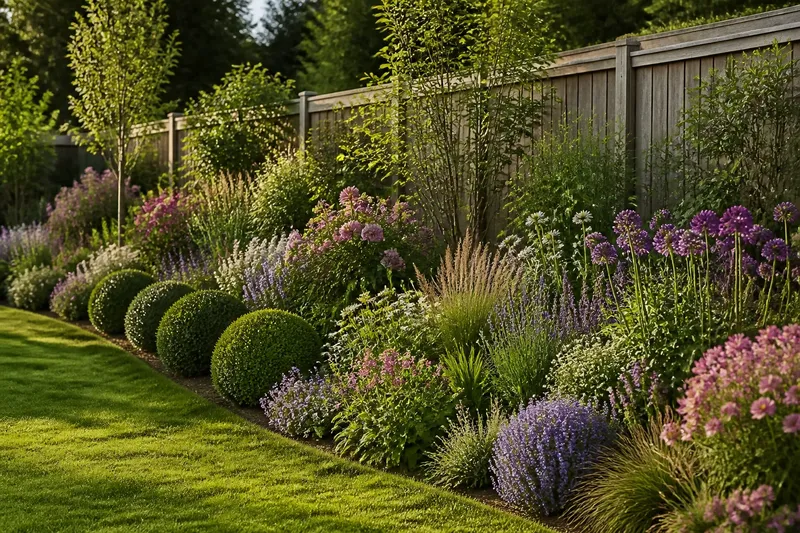
A Winter Garden Read Through Silhouette
Use a winter garden silhouette to identify which dormant stems and evergreen shapes deserve room, then make a focused edit that clarifies the border.
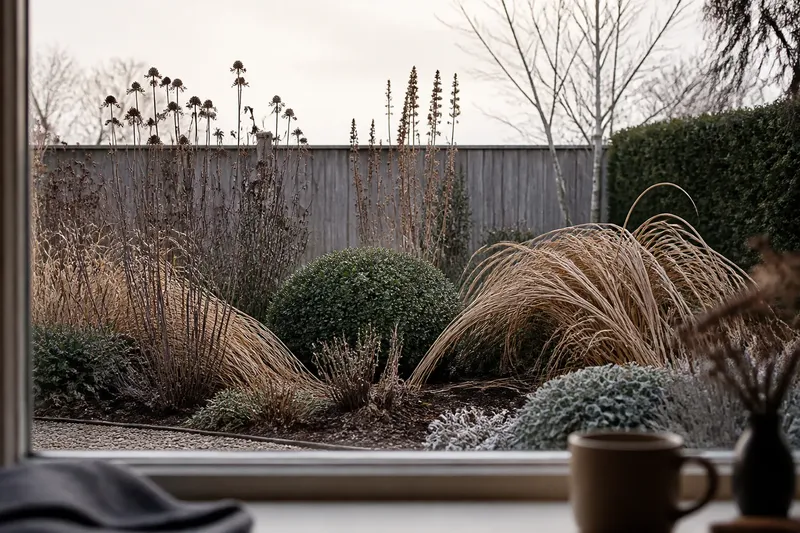
Which dormant plants still give your garden a clear shape, and which have collapsed into a tangle? A winter garden silhouette makes that decision easier by drawing attention to outlines against fences, hedges, or open sky. You can use it to choose which stems to leave, which to cut back, and where a gap should remain.
Choose a view
Stand at the window, doorway, or patio where you most often see the border. Look at the plants against their actual background: fine stems may show clearly against a plain fence but disappear into a busy hedge.
Now ignore color and focus on the shapes. Notice seed heads, evergreen foliage, arching grasses, and bare stems as separate marks, then check whether neighboring forms have distinct edges or have merged into a single patch.
Compare three forms
Winter borders often rely on a combination of upright, rounded, and arching shapes. You do not need every form in every bed; choose based on what the view lacks.
Upright stems
Seed heads, sturdy perennial stems, and narrow evergreen forms can create clear vertical marks. Repeated upright shapes offer more order than a scatter of unrelated spikes, while lower plants or open gaps keep them from reading as one solid fence-like band.
Rounded foliage
Evergreen shrubs and low mounds provide a stable counterpoint to fine stems. A rounded form can make nearby uprights easier to distinguish, but two similar mounds pressed together may read as one indistinct mass.
Arching growth
Grass blades and other arching forms soften the edges between upright stems and low plants. Leave them where their outline remains recognizable; cut back material that has collapsed into a dark tangle or blocks a useful view, following the plant’s care guidance and local conditions.
Read the gaps
The empty shapes between plants matter as much as the plants themselves. Look for a strip of fence showing above a shrub, an opening beneath an arching grass, or a pocket of sky between stems. These spaces can make a border feel airy, while narrow gaps that close up visually can make it seem crowded.
Open ground looks intentional when it has a clear edge or relates to the rest of the bed. A visible sweep of mulch or a simple low planting can define a gap; if bare soil looks like an accidental hole, consider whether the planting boundary needs adjustment rather than filling every space.
Make one clear edit
Use the shape that needs attention to choose an action. A collapsed stem can be cut back when appropriate; an upright form obscured by a neighboring plant may need space; a border with already distinct outlines may need no change. Avoid tidying every stem simply to make the bed uniform.
Say you are looking from a kitchen window at a border where two dried grass clumps have fallen across a rounded evergreen. In this invented situation, you identify the tangled stems as the source of the blur, check the grasses’ care guidance, and cut back only the collapsed material at a suitable time. The expected result is a visible evergreen outline and a clearer opening between the remaining upright stems; if the stems are still firm and useful, leave them rather than cutting for neatness.
- Observe whether upright stems remain firm and distinct; if they do, leave them standing, but if they have collapsed into a tangle, check the plant’s care guidance before cutting them back.
- Observe whether a rounded evergreen has a visible edge; if neighboring stems hide it, remove or support only the obstructing material, but if its outline is already clear, leave the surrounding plants alone.
- Observe whether arching grass forms a recognizable curve; if the blades have collapsed into a mass, cut them back at an appropriate time, but if the curve remains clear, preserve it.
- Observe whether a gap separates two neighboring forms; if it does, keep the opening, but if the outlines still merge, selectively clear the obstructing growth rather than planting into the gap.
- Observe whether bare soil has a defined edge; if mulch or a planting boundary makes it look intentional, leave it open, but if it reads as an accidental hole, adjust the boundary or consider a low planting.
- Observe whether fine stems contrast with their background; if a busy hedge swallows their outline, favor a clearer placement or background where feasible, but if the stems read distinctly, avoid changing the setting.
Winter garden silhouette questions?
Which plants hold their shape?
Evergreen shrubs, ornamental grasses, seed heads, and sturdy dormant stems can remain recognizable after flowers fade. Keep the forms that read clearly in your chosen view, rather than relying on a plant label alone.
Should every perennial stay standing?
No. Leave stems that contribute a distinct outline and remove material that has collapsed or obstructs the border, using the plant’s care guidance and local conditions to choose timing.
How much open space should remain?
Keep gaps that help neighboring shapes remain distinct without making the bed look unfinished. If open soil seems accidental, define its edge or consider a low planting instead of filling every gap.
What is not worth the effort?
It is not worth trimming every stem into a uniform outline for the sake of neatness. That can erase useful differences in height and texture; focus only on growth that has become unclear or obstructive.
A winter garden silhouette is a way to decide what deserves to remain visible, not a demand to keep every border on display. Before making a larger change, check the plant’s needs and consider how the edit will affect the garden beyond this one view. The clearest winter shape may be the space a plant leaves open.