Clipped, Loose or Layered: Three Ways to Shape a Border
Compare clipped, loose, and layered border planting to choose a character for your garden, with a worked sketch showing how grouped plants soften a fence.
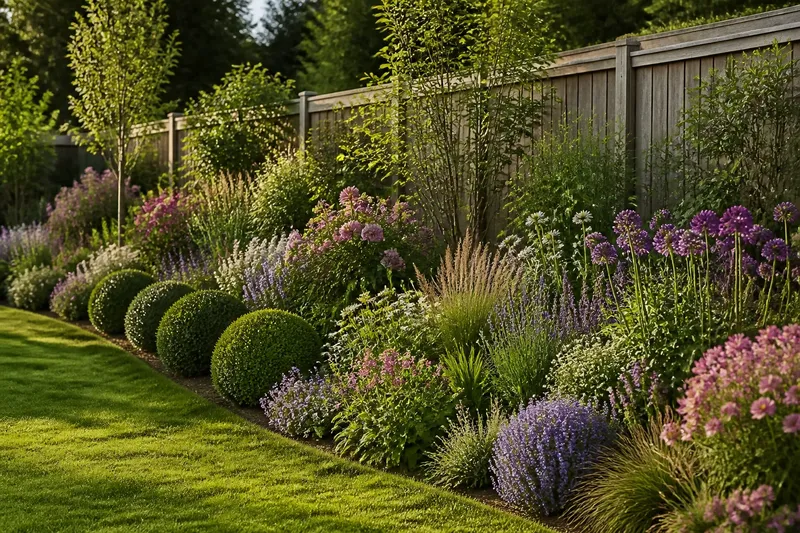
Which border planting will soften a fence without making the garden feel cluttered? Clipped, loose, and layered border planting each organizes plants differently, so the best starting point is the effect you want and the care you are willing to take on.
Use a quick plan to compare the options before buying plants. Mark the lawn edge, fence, existing trees, and the main viewing spots, then draw broad shapes rather than individual specimens. A pencil, tracing paper, and a few colored pencils are enough.
Three planting structures
Clipped planting builds its character from repeated shapes, such as a sequence of compact mounds along the lawn. Loose planting groups plants in flowing drifts, with overlapping edges and a less formal outline. Layered planting arranges forms at different heights and depths, often with lower plants near the lawn and taller ones toward the fence.
These structures can overlap, but give one of them the leading role. A border with a clipped edge and loose groups behind it can still feel coherent; several equally prominent patterns may compete for attention.
Clipped border planting
Repeated, clearly defined forms make a border feel orderly. A sketch might show matching evergreen mounds along the lawn edge, with flowering perennials behind them. The repeated outline frames the planting, but it also makes trimming part of the design’s upkeep.
Keep the number of shapes restrained. A row of matching forms is easier to read than a sequence of unrelated outlines, and clipping every plant into a hard-edged shape can make the border feel like a display of objects. Before choosing this approach, check plant labels for growth habit and care needs; if regular shaping does not suit your routine, choose a looser structure instead.
Loose drift planting
Drifts are groups of plants that flow into one another rather than forming a strict line. Repeating a few groups gives the border a relaxed character without making it look accidental. Fine stems and airy grasses can keep a planting visually light, while broad leaves can make it feel fuller.
On the plan, draw broad sweeps rather than dots for every plant. If each group has a recognizable direction or repeats elsewhere, the border is more likely to read as one composition; if every species stands alone, reduce the number of groups or repeat the strongest ones.
Layered border planting
Layers give a border depth: low plants near the lawn, fuller middle groups, and taller forms toward a fence or hedge. The background does not have to be tall, but a sequence of heights can stop a border from reading as one flat strip.
Check the arrangement from the places where you actually see it, such as the lawn and a nearby window. If a broad, dense plant hides a smaller group, shift the smaller group forward or leave an opening. Avoid arranging every height in a rigid row; some overlap makes the planting feel connected.
Which planting style fits?
What does clipped planting require?
It requires plants suited to defined forms and recurring attention to their outlines. If that upkeep sounds unwelcome, use repeated groups without relying on clipped shapes.
How can loose drifts stay coherent?
Repeat a limited set of plant groups and give the drifts a shared direction or rhythm. If the sketch looks scattered, simplify the palette or repeat the most prominent groups.
Does a layered border need a fence?
No. Taller plants can form a backdrop, but a border can also use a modest range of heights without a tall boundary behind it. Choose a sequence that fits the view and confirm each plant’s mature form on its label or with the supplier.
Can these structures be combined?
Yes, as long as one structure leads. A low clipped edge can sit in front of loose drifts, or layered planting can use a repeated clipped form as an accent; if both treatments dominate, simplify one.
From plan to planting
Say you have an invented, hypothetical border beside a plain lawn and a long fence, and you want to soften the boundary without a formal row. Mark the lawn, fence, and viewing spots on paper, then sketch low, middle, and tall zones. In one version, draw rounded shapes along the lawn; in another, draw broad drifts; in a third, combine loose groups with a low-to-tall sequence. The comparison shows which plan keeps a visible lawn edge while making the fence less prominent.
For this invented plan, the preferred version uses low plants at the front, fuller groups in the middle, and taller forms near the fence, with the same groups recurring in loose drifts. Before selecting plants, check the available light, space, mature size, growth habit, and care needs against labels or supplier guidance. If a candidate would crowd a neighboring group at maturity, replace it or redraw the spacing.
- Check the border’s available light against each plant’s label; if the conditions do not fit, choose a better-suited plant.
- Check mature size against the space on the sketch; if neighboring forms would crowd, increase their separation or select a smaller-growing plant.
- Check the desired outline against your willingness to trim; if regular shaping is unwelcome, use repeated untrimmed groups instead.
- Check whether each drift appears more than once; if a group has no visual partner, repeat it or remove it.
- Check the plan from the lawn and a nearby window; if a smaller group disappears, move it forward or open a gap.
- Check whether the fence still dominates the drawing; if it does, extend suitable taller planting toward the background, or accept the fence as a visible feature.
It is not worth buying one of every plant that catches your eye or trying to make every season equally showy. Both choices can dilute the border’s character. Keep a focused group of plants whose forms and care needs suit the site, then let the repeated pattern do the organizing.
Keep the design legible
After the sketch works from the lawn and the house, choose plants for the actual conditions and revise the plan around their mature forms. The aim of loose layered border planting is not to fill every gap; it is to balance a readable edge with groups that soften the boundary. Carry the pattern into one portion first, then use what you see there to decide whether the rest of the border needs the same balance.